Google Business Profile in the AI Search Era: A Monthly Checklist for Tulsa Owners
A practical monthly Google Business Profile checklist for Tulsa and Oklahoma small businesses preparing for AI-shaped local search.
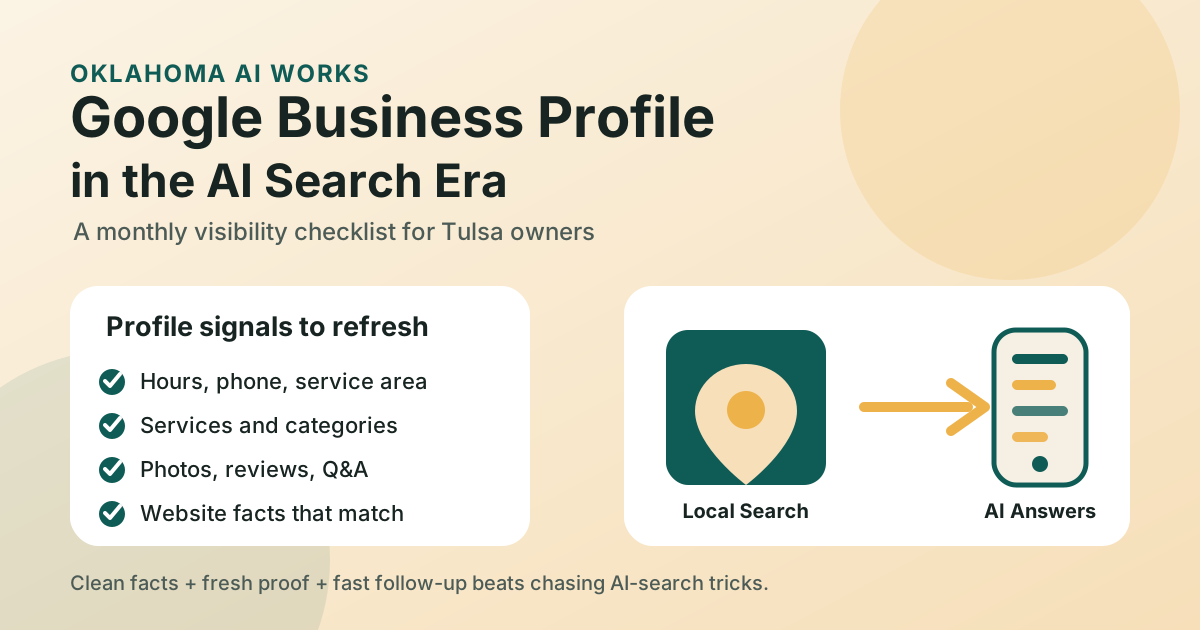
AI search has not made your Google Business Profile less important. If anything, it has made the boring profile details matter more.
When someone asks Google, Maps, or an AI assistant for “a roofer near me,” “best pest control in Broken Arrow,” or “salon open after work in Tulsa,” the system still needs trusted facts: what you do, where you work, when you are open, what customers say, and whether your website backs it up. Those facts often start with your Google Business Profile.
The mistake is treating the profile like a one-time setup task. You claim it, add a logo, maybe upload three photos, and then forget it exists. Meanwhile your hours change, services drift, reviews pile up, competitors keep posting, and Google may suggest or auto-display details that are not quite right.
Here is a simple monthly checklist for Tulsa and Oklahoma business owners who want to stay visible without turning local SEO into a second job.
First: what Google says actually matters
Google describes local ranking around three main factors: relevance, distance, and prominence. Distance is mostly out of your control. If someone is in Jenks, Google knows they are in Jenks. But relevance and prominence are where a business owner can make real progress.
Relevance means Google can understand what your business does and match it to the search. Prominence means the business looks established and trusted, based on signals like reviews, links, and general online presence.
Google also says there are no special technical tricks required to appear in AI Overviews or AI Mode. The same fundamentals still apply: helpful content, crawlable pages, accurate business information, useful text on your website, and details that match what customers actually see.
That is good news. You do not need an “AI SEO hack.” You need clean business facts, current proof, and a habit of checking them.
1. Check your name, categories, and service area
Start with the basics because they are the easiest to get wrong.
Your business name should be the real name customers see on your sign, truck, invoice, or website. Do not stuff keywords into it. “Green Country Pest Control” is fine. “Green Country Pest Control Best Exterminator Tulsa Broken Arrow” is asking for trouble and can put your profile at risk.
Next, review your primary category. This is one of the strongest relevance signals in the profile. A med spa, HVAC contractor, pest control company, roofing crew, dental office, or salon should be categorized as specifically as Google allows. Then add secondary categories only when they describe real services you provide.
Finally, check your service area. For Tulsa-area service businesses, this may include cities like Tulsa, Broken Arrow, Bixby, Jenks, Owasso, Sand Springs, Sapulpa, Claremore, or Skiatook. Keep it honest. A wide service area that you cannot actually serve well creates bad leads and disappointed customers.
Monthly task: confirm your category and service area still match the work you want more of.
2. Update hours before they become a customer-service problem
Wrong hours are not just an SEO issue. They are a trust issue.
If your profile says you are open and nobody answers, the customer does not think, “Google made a mistake.” They think you made a mistake. Around holidays, weather closures, staff shortages, and seasonal schedules, this is especially easy to miss.
For Oklahoma service businesses, hours can also change during demand spikes. A roofing company after hail, an HVAC company in August, a plumbing company during a freeze, or a tree service after storms may handle calls differently for a few weeks. If your public profile and your actual response process do not match, leads leak out.
Monthly task: check regular hours, holiday hours, phone number, website link, appointment link, and messaging settings if enabled.
3. Make sure services are specific enough for real searches
A thin services section forces Google and customers to guess.
If you are a pest control company, do not only list “pest control.” Add the real service language people use: termite inspections, mosquito treatment, roach treatment, ant control, rodent exclusion, quarterly pest plans, commercial pest control, and the cities you serve where appropriate.
If you are a salon, list haircuts, color, extensions, bridal styling, men’s cuts, kids’ cuts, or whatever truly fits. If you are a roofer, list roof repair, storm damage, leak repair, roof replacement, inspections, gutters, and emergency tarping if you actually offer it.
This helps human customers, and it helps search systems connect your business to more specific questions.
Monthly task: add one missing service, remove anything you no longer offer, and make sure your website has a matching page or section for your most important services.
4. Add fresh photos that prove the business is alive
Photos are not magic, but they are useful evidence. They show customers that the business is real, current, and local.
You do not need a professional shoot every month. A few honest photos can do the job:
- a finished job, with permission where needed
- a clean truck or storefront
- your team at work
- seasonal inventory or service equipment
- before-and-after photos when appropriate
- a local project that clearly looks like Green Country, not a stock image
Avoid uploading anything that reveals customer private information, license plates, addresses, medical details, or other sensitive content. Practical beats flashy here.
Monthly task: add two to five real photos and remove anything outdated, low-quality, or misleading.
5. Respond to reviews like future customers are reading
Because they are.
Reviews help prominence, but the response is where a business can show its personality. A short, human reply tells customers you are paying attention. It also gives Google more context about what you do, as long as you write naturally and do not force keywords.
Good response:
Thanks, Amanda. Glad we could get the AC running again before the weekend. We appreciate you calling us for the repair in Broken Arrow.
Bad response:
Thank you for choosing BEST HVAC REPAIR TULSA BROKEN ARROW AIR CONDITIONING COMPANY.
Respond to negative reviews calmly. Do not argue, disclose private details, or try to win the courtroom drama. The point is to show the next reader that you are reasonable and responsive.
Monthly task: reply to every new review you missed, and build a simple habit for asking happy customers at the right moment.
6. Check Q&A and suggested edits
Google profiles can collect questions, answers, and suggested changes. Some are helpful. Some are wrong. Some are from customers who could not find the information on your website.
Look for questions like:
- Do you serve Owasso?
- Do you offer emergency appointments?
- Are estimates free?
- Do you treat termites?
- Do you work with insurance claims?
- Do you take walk-ins?
These questions are clues. If people ask them on your profile, they should probably be answered on your website too. That helps traditional search, AI-shaped search, and real customers who just want a quick answer.
Monthly task: review Q&A, correct bad information, and turn repeated questions into website FAQ content.
7. Make your website match your profile
Your Google Business Profile should not tell one story while your website tells another.
Check the basics:
- same business name
- same phone number
- same address or service-area language
- same hours
- same primary services
- same appointment or contact path
- clear pages for your most important services
- plain text that says what you do and where you do it
This matters more as AI tools summarize businesses. If one source says you offer emergency service and another does not, the system has to choose. If your profile, website, reviews, and content all agree, you make that choice easier.
Monthly task: compare your profile to your homepage, contact page, and top service pages. Fix mismatches.
8. Look at performance, but do not obsess over rankings
Google Business Profile performance data can show calls, direction requests, website clicks, bookings, messages, and search terms. It is worth checking, but it is not worth turning into a daily anxiety ritual.
Look for useful patterns:
- Which services are people finding you for?
- Are calls increasing after new reviews or profile updates?
- Are people clicking to the site but not contacting you?
- Are certain searches bringing poor-fit leads?
- Are mobile visitors getting a fast, clear next step?
The goal is not to chase every fluctuation. The goal is to learn what customers are asking for and make the next month cleaner.
Monthly task: record the top takeaways, then pick one improvement for the profile or website.
A 30-minute monthly routine
If you only have half an hour, do this:
- Confirm hours, phone, website, categories, and service area.
- Add or clean up one service.
- Upload a few current photos.
- Reply to reviews.
- Check Q&A and suggested edits.
- Make sure the website matches the profile.
- Note one customer question you should answer better next month.
That is not glamorous. It is also more useful than most AI-search advice floating around right now.
Where AI can actually help
AI is useful here when it supports the routine instead of replacing your judgment.
It can summarize new reviews, draft polite response options, spot repeated customer questions, turn call transcripts into FAQ ideas, remind you to update seasonal services, and help keep your website language aligned with your Business Profile. It should not invent services, exaggerate claims, or answer sensitive customer questions without guardrails.
Oklahoma has hundreds of thousands of small businesses, and most of them are not going to win by chasing every marketing trend. They win by being easy to find, easy to understand, and easy to contact at the moment a customer is ready.
That is the practical version of AI search readiness: keep the facts clean, keep the proof fresh, and make sure someone answers when the lead shows up.
Want help keeping the profile, website, and customer follow-up aligned? Oklahoma AI Works helps local businesses turn search traffic into answered questions, cleaner intake, and real follow-up. Visit okaiworks.com/contact to start a conversation.
Sources reviewed
- Google Business Profile Help: Guidelines for representing your business on Google
- Google Business Profile Help: Tips to improve your local ranking on Google
- Google Search Central: AI Features and Your Website
- U.S. Small Business Administration Office of Advocacy: 2025 Small Business Profile for Oklahoma