A 4.8-Star Rating Can Still Look Abandoned: A 15-Minute Google Review Audit
A practical 15-minute Google review audit for Tulsa businesses: check recency, responses, authenticity, and policy-safe review requests.
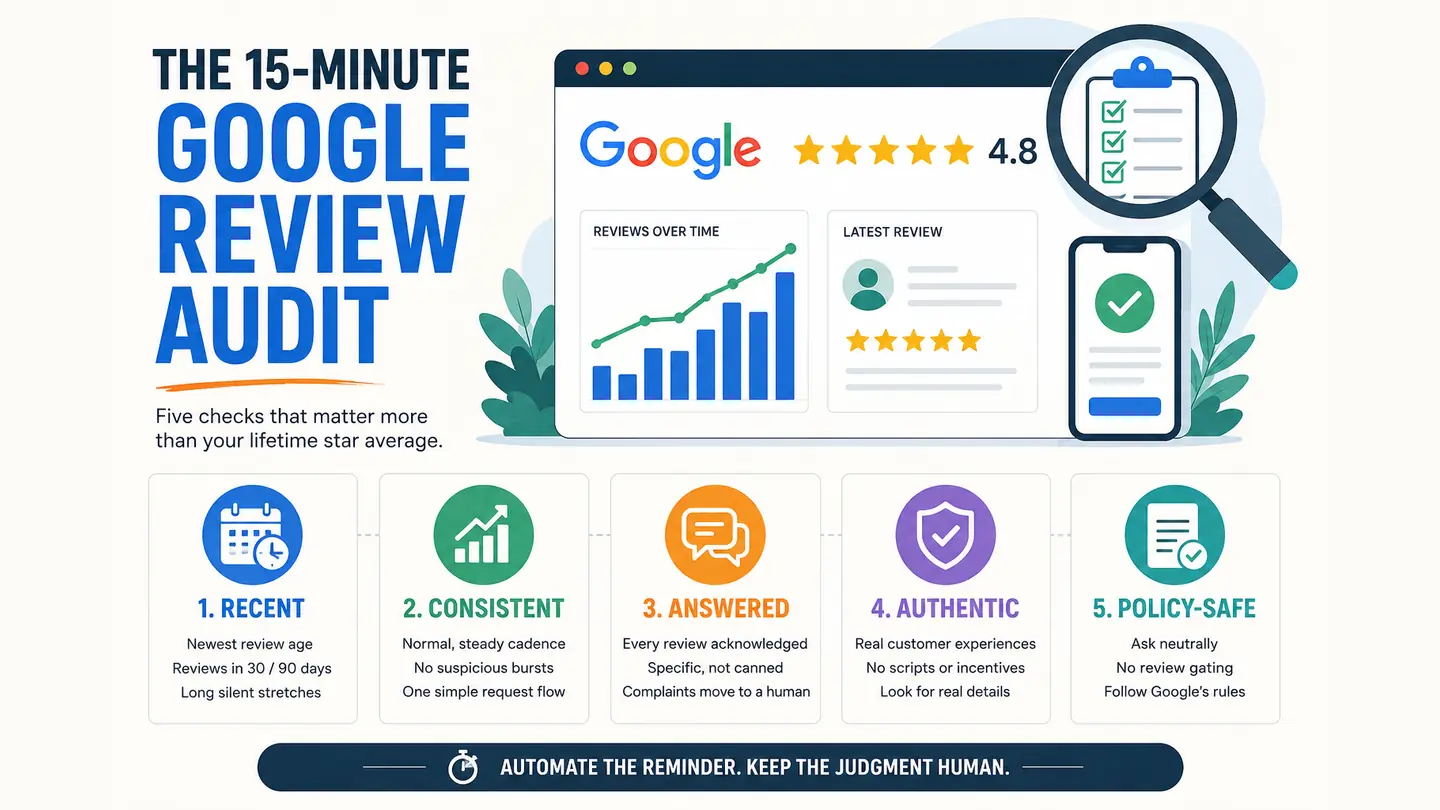
A 4.8-star rating looks good. It can also hide a review profile that has gone quiet.
Maybe the newest review is six months old. Maybe the last ten arrived in one suspicious burst. Maybe customers keep mentioning the same communication problem and nobody has answered them. Or maybe a well-meaning employee has been offering discounts for five-star reviews—a shortcut that can violate Google’s rules and create a federal compliance problem.
Your lifetime average cannot tell you any of that.
The useful question is not simply, “How many stars do we have?” It is, “Does our review profile look current, credible, responsive, and real?” You can answer that in about 15 minutes.
Why review recency deserves your attention
People use reviews to reduce uncertainty. They want to know whether the company answering the phone today is still doing good work—not whether it did good work three years ago.
BrightLocal’s 2026 Local Consumer Review Survey found that consumers expect stronger ratings and fresher reviews, and that use of generative-AI tools for local recommendations rose sharply among its respondents. It is an industry survey, not Google’s ranking formula, but the direction is useful: people are checking more sources and looking for current evidence before choosing a business.
Google’s own local-ranking guidance says reviews and positive ratings can help a business stand out. Google does not publish a magic monthly quota, and anyone promising one is guessing. The practical goal is simpler: earn honest reviews at a steady pace and respond like a business that is paying attention.
For a Tulsa-metro pest-control company with recurring plans, a higher-ticket residential remodeling or repair firm, or a residential/light-commercial electrical company focused on service work rather than new construction, that matters because customers often compare several similar companies in one sitting. A strong rating gets you considered. A recent, specific review may be what makes the customer call.
The five-part audit
Set a 15-minute timer, open your Google Business Profile, and write down what you find. Do not fix anything yet. First get an honest baseline.
The goal is not a perfect score. It is a review process that looks active, earns trust, and stays inside the rules.
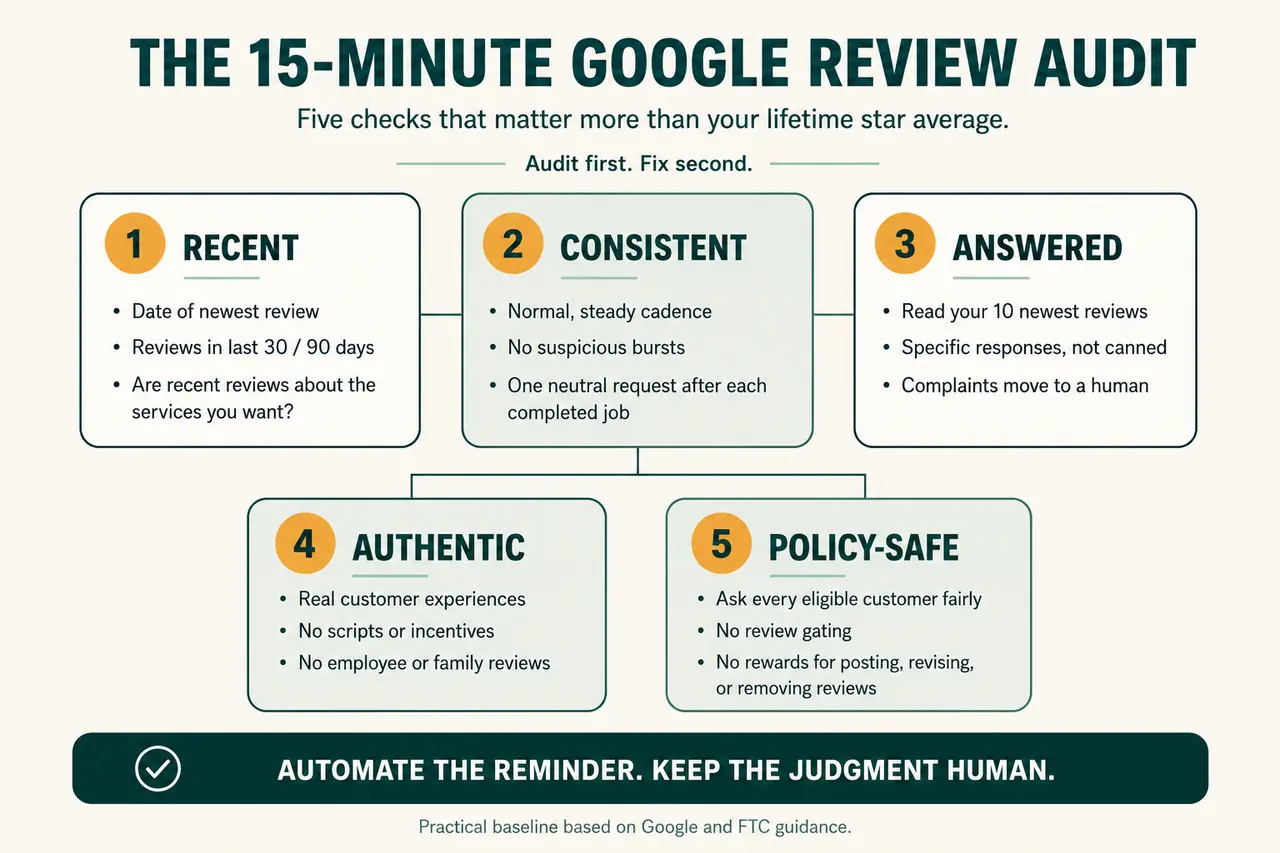
1. Recent: When did the newest review arrive?
Write down three things:
- The date of your newest review
- How many reviews arrived in the last 30 days
- How many arrived in the last 90 days
There is no universal “right” number. A two-crew pest-control company and a remodeling firm completing six large projects a year should not have the same review cadence.
Compare reviews with completed jobs instead. If you finished 40 jobs in the last 90 days and received no reviews, the process is probably missing—not the customer goodwill.
Also look at what recent reviewers mention. Are they describing services you still want? A company can have hundreds of reviews and still send the wrong signal if the newest ones all describe work it no longer prioritizes.
2. Consistent: Does the pattern look natural?
Scroll through the last year. You are looking for rhythm, not volume.
A healthy profile usually reflects the pace of the business: some busy periods, some slower weeks, and reviews written in different voices. A long silence followed by 20 generic five-star reviews in two days can look unnatural even if every customer was real.
Common causes are less sinister than they appear. Someone remembers reviews once a quarter, sends a mass text to an old customer list, then forgets again. That creates bursts instead of a dependable habit.
The better system is boring: after each eligible completed job, send one neutral request on a consistent delay. Do not pressure the customer, write the review for them, or ask staff to hit a quota.
3. Answered: Does the business respond like a human?
Read your ten newest reviews and check whether each one has a response.
A response does not need to be long. It needs to show that somebody read what the customer wrote. Compare these:
“Thank you for your business. We value your feedback.”
That could be pasted under any review for any company.
“Thanks, Maria. I’m glad Caleb found the entry point behind the pantry and explained what to watch for next. We appreciate you trusting us with the house.”
The second response mentions the actual experience without exposing private information. It sounds like a local business because it is specific.
For critical reviews, the goal changes. Do not argue, diagnose the customer, publish account details, or let an automated system post a defensive reply. Acknowledge the concern briefly, invite a direct conversation, and move the service-recovery work to a human.
4. Authentic: Could these reviews have come from real customers?
Look for repeated wording, unexplained clusters, reviews from employees or family members, and reviews describing services you do not provide. Google treats employment and family relationships as conflicts of interest, so disclosure does not make those Google Maps reviews permissible.
Then inspect your own request process. Google’s fake and misleading content policy says reviews should reflect genuine experiences. It prohibits paid or incentivized reviews, conflicts of interest, and attempts to manipulate ratings.
That means no buying reviews, no asking an agency to “seed” the profile, and no handing customers a paragraph to paste. Giving people prompts such as “What service did we perform?” can also pressure them toward scripted language. A direct link and a neutral request are enough.
Authentic reviews will not all be perfect. That variation is part of what makes them believable.
5. Policy-safe: Are you asking everyone fairly?
This is where many otherwise honest businesses get into trouble.
Google says merchants may not selectively solicit positive reviews. In other words, you should not ask presumed happy customers for a Google review while routing dissatisfied customers into a private form that prevents them from seeing the same public-review option. That practice is often called review gating.
Incentives create another problem. “Leave us a five-star review for 10% off” violates Google’s policy and the FTC rule’s ban on incentives conditioned on positive or negative sentiment. Google goes further: it prohibits incentives for posting any Maps review, as well as incentives for revising or removing a negative review. The FTC’s Consumer Reviews and Testimonials Rule guidance says the rule took effect October 21, 2024, and courts may impose civil penalties for knowing violations. FTC staff says sentiment-neutral incentives are not prohibited by the rule itself, although disclosure and other FTC Act requirements may still apply.
The safer operating rule is straightforward:
- Send one neutral request to every customer who meets a documented, rating-blind eligibility rule—for example, a completed job, a permitted contact channel, and no prior request
- If requests are sent by text, follow applicable consent and quiet-hour requirements and honor STOP immediately
- For Google reviews, never offer a reward for posting a review or for revising or removing a negative one
- Never predict sentiment and filter recipients accordingly
- Let customers use their own words
- Keep complaint recovery separate from review eligibility
This is not legal advice. It is a practical baseline drawn from the platforms’ and regulator’s published guidance.
A review-request message that does not sound desperate
A good request is short, specific about the business, and neutral about the rating:
Thanks for choosing [Business Name] today. If you have a minute, would you share an honest review of your experience? It helps local customers know what working with us is like: [direct review link]
That message does not ask for five stars. It does not offer anything. It does not tell the customer what to say. And it makes clear that honest feedback is welcome.
One request is usually enough. Repeated messages can turn a positive experience into an annoying one.
What to automate—and what should stay human
Automation is useful when it creates consistency, not when it manufactures enthusiasm.
A sensible review workflow can:
- Trigger one neutral request after a completed job
- Use the same eligibility rule for every customer
- Send during reasonable daytime hours
- Record whether the request was delivered
- Detect new reviews
- Draft a short response in the company’s voice
- Put sensitive or low-rating responses in a human review queue
The human still decides how to resolve a complaint. The human checks that a drafted response is accurate. And the human owns the policy.
A safe division of labor is simple: automation handles timing and recordkeeping; a person verifies drafted responses and handles complaints.
Your 15-minute scorecard
Before closing the profile, record five simple results:
- Recent: newest review date and reviews in the last 30/90 days
- Consistent: steady cadence, long gaps, or unnatural bursts
- Answered: percentage of the ten newest reviews with specific responses
- Authentic: any repeated, incentivized, conflicted, or questionable content
- Policy-safe: neutral request to every eligible customer, with no gating
Then choose one improvement for the next month. Not five. One.
For most businesses, the best first move is setting a consistent, neutral request after each completed job. If requests are already working, focus on responses. If both are working, study the language customers use and improve the service pages and FAQs that future customers will read next.
A review profile should not be a trophy case from the past. It should be current evidence that the business is still doing careful work and paying attention when customers speak.
Want to talk through how this fits your front desk? Talk with Oklahoma AI Works.